

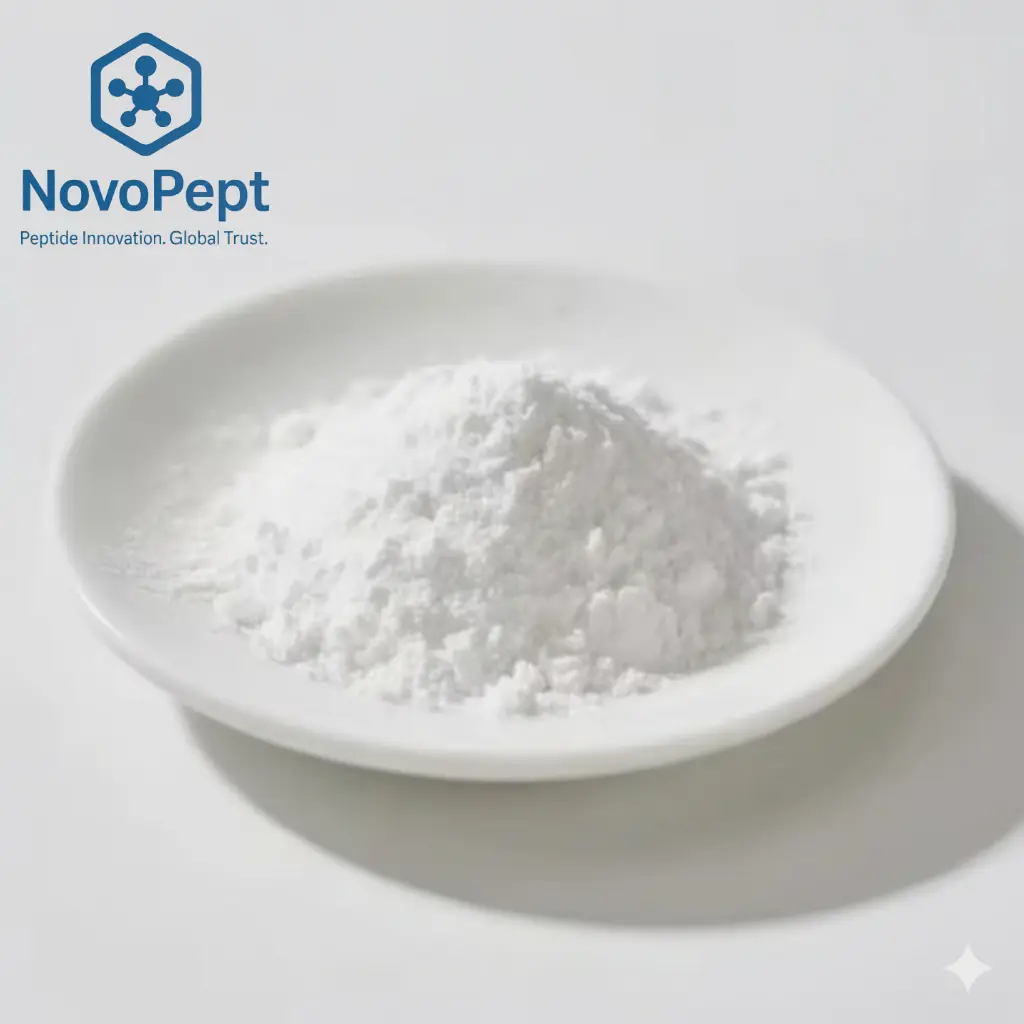
Oleoylethanolamide CAS No.: 111-58-0
What Is Oleoylethanolamide? Oleoylethanolamide (OEA) is a naturally occurring fatty acid ethanolamide and an endogenous lipid mediator involved in energy balance, appetite regulation, and lipid metabolism signaling . It is structurally related to endocannabinoid-like compounds but operates...
What Is Oleoylethanolamide?
Oleoylethanolamide (OEA) is a naturally occurring fatty acid ethanolamide and an endogenous lipid mediator. It plays a critical role in energy balance, appetite regulation, and lipid metabolism signaling.
While structurally related to endocannabinoid-like compounds, OEA operates through distinct metabolic and nuclear receptor pathways. It is extensively studied as a key metabolic signaling molecule and is widely used in research focusing on weight management, lipid metabolism, and advanced nutraceutical formulations.
Novopept is a direct OEA manufacturer, providing high-purity peptide raw materials with strict quality control and long-term supply stability.
Technical Data
· Name: Oleoylethanolamide (OEA)
· Synonyms: N-Oleoylethanolamine; N-(2-Hydroxyethyl)-9Z-octadecenamide
· CAS Number: 111-58-0
· Molecular Formula: C₂₀H₃₉NO₂
· ·Molecular Weight: ~325.53 g/mol
· Appearance: White to off-white powder/solid
· Melting Point: ~50–60°C
· Density: ~0.9 ± 0.1 g/cm³
· Boiling Point (theoretical): ~496°C at 760 mmHg
Flash Point: ~254°C
Soluble in organic solvents such as DMSO (≈25 mg/mL) and ethanol (≈35 mg/mL)
Storage: 2–8°C in fridge recommended for product stability over weeks

Mechanism of Action (MOA)
Oleoylethanolamide exerts its biological activity primarily through PPAR-α (Peroxisome Proliferator-Activated Receptor Alpha) activation rather than direct cannabinoid receptor binding.
Key mechanisms studied include:
- Activation of PPAR-α–mediated lipid oxidation pathways
- Regulation of satiety signaling and feeding behavior
- Modulation of fatty acid uptake and utilization
- Influence on energy homeostasis and metabolic efficiency
This receptor-mediated mechanism differentiates OEA from stimulant-based or thermogenic compounds.
Benefits of Oleoylethanolamide
Based on preclinical and mechanistic research, OEA has been investigated for:
- Appetite and satiety signaling regulation
- Fat oxidation and lipid metabolism modulation
- Body weight management–related pathways
- Metabolic inflammation and oxidative balance
- Gut–brain axis signaling research
All benefits described are research-oriented and not intended as consumer claims.
Applications of Oleoylethanolamide
Weight Management & Metabolic
- Satiety-related signaling studies
- Fat metabolism and oxidation pathway research
- Energy balance and feeding behavior models
Nutraceutical & Functional Ingredient
- Lipid-based ingredient formulation
- Synergistic metabolic ingredient studies
- Controlled-release and bioavailability research
General Research Use
- PPAR-α signaling pathway studies
- Endogenous lipid mediator research
- Metabolic regulation models
palmitoylethanolamide and Oleoylethanolamide
Palmitoylethanolamide (PEA) and oleoylethanolamide (OEA) are both endogenous fatty acid ethanolamides with similar structures but distinct biological functions.
PEA is primarily studied for its role in cellular homeostasis and inflammatory regulation, acting mainly through PPAR-α–mediated pathways. Research focuses on its involvement in immune modulation, neuroinflammation, and tissue protection, rather than direct metabolic control.
OEA, by contrast, is more closely linked to energy balance and lipid metabolism. It activates PPAR-α–dependent signaling associated with fatty acid oxidation, satiety, and gut–brain metabolic communication, making it a key subject in appetite and metabolic research.
While both compounds interact with PPAR-α, PEA is positioned as a homeostatic regulator, whereas OEA functions as a metabolic signaling molecule. They are therefore not interchangeable but may be explored as complementary lipid mediators in research and formulation development.
Oleoylethanolamide (OEA) vs Berberine
Oleoylethanolamide and berberine are both widely studied metabolic ingredients, but they function through distinct biological pathways and serve different formulation roles.
Key Differences
| Attribute | OEA | Berberine |
|---|---|---|
| Chemical Class | Fatty acid ethanolamide | Isoquinoline alkaloid |
| Endogenous | Yes | No |
| Primary Pathway | PPAR-α signaling | AMPK activation |
| Main Research Focus | Satiety and lipid oxidation signaling | Glucose and lipid metabolism |
| Functional Role | Targeted metabolic signaling | Broad metabolic regulation |
Research Positioning
- OEA is studied as an endogenous lipid mediator involved in satiety signaling and PPAR-α–regulated lipid metabolism.
- Berberine is researched as a multi-pathway metabolic modulator, primarily through AMPK-related energy regulation.
Formulation Perspective
OEA is typically positioned as a precision signaling ingredient, while berberine functions as a core metabolic regulator. They are often evaluated as complementary, rather than interchangeable, components in metabolic research formulations.
Where to Source premium quality Oleoylethanolamide
Choose NovoPept Biotech as your reliable supplier for Oleoylethanolamide powder in china.
High Purity & Consistency: Oleoylethanolamide powder is produced in cGMP-certified facilities, with ≥99% purity (HPLC).
✅ Comprehensive Documentation: Full COA (Certificate of Analysis),third-party lab reports.
✅ Scalable Supply: Bulk quantities(Monthly capacity of 500+ kg) available to support ongoing research programs and OEM Service for Oleoylethanolamide hard capsule, tablet, and soft gel.
✅ Global B2B Support: Export-ready for qualified research partners worldwide.
Scientific References
- Tutunchi H., Saghafi-Asl M., Ostadrahimi A. (2020). A systematic review of the effects of oleoylethanolamide, a high-affinity endogenous ligand of PPAR-α, on the management and prevention of obesity. https://doi.org/10.1111/1440-1681.13238
- Lo Verme J., Fu J., Astarita G., Miura E., et al. (2005). Oleoylethanolamide regulates feeding and body weight through activation of the nuclear receptor PPAR-alpha. https://pubmed.ncbi.nlm.nih.gov/12955147/
- Fu J., Gaetani S., Oveisi F., Lo Verme J., et al. (2003). Oleoylethanolamide stimulates lipolysis by activating the nuclear receptor PPAR-alpha. https://pubmed.ncbi.nlm.nih.gov/15123613/
- Payahoo L., Khajebishak Y., Barzegari A., et al. (2018). Oleoylethanolamide increases the expression of PPAR-α and reduces appetite and body weight in obese people: A clinical trial. https://pubmed.ncbi.nlm.nih.gov/29787831/
- Saghafi-Asl M., Ostadrahimi A., et al. (2019). Oleoylethanolamide: A novel agent in energy homeostasis and feeding behavior control. https://pubmed.ncbi.nlm.nih.gov/30537148/
- Salahshoor M.R., Roshangar L., Dehpour A.R. (2022). Effects of oleoylethanolamide supplementation on hepatic lipid metabolism-related genes in NAFLD patients. https://pubmed.ncbi.nlm.nih.gov/32217148/
- Scientific Reports (2012). Oleoylethanolamide exerts anti-inflammatory effects by enhancing PPAR-α signaling. https://www.nature.com/articles/srep34611
-
Whatsapp:+852 6736 4057
-
Telegram:@hinovopept
-
Email:novopept@gmail.com

Hot Tags: oleoylethanolamide cas no.: 111-58-0, China oleoylethanolamide cas no.: 111-58-0 manufacturers, suppliers, factory



Send Inquiry
